Suzuki V-Strom 650 vs Kawasaki Versys 650: Spec Comparison
The Suzuki V-Strom 650 is the Japanese manufacturer’s middleweight adventure tourer. The bike is here in Malaysia, yet not many of us knows about it. It will directly compete against the Kawasaki Versys 650 in the country, and the rest also has good machines like Yamaha and Honda or Triumph or Ducati and Benelli.


We see how the rivals fare against each other on paper.


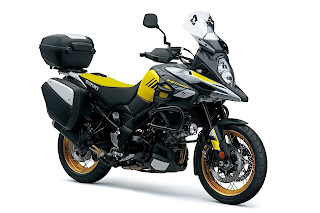
ENGINE
Type: Liquid-cooled, transverse 90-degree V-twin
Displacement: 645cc
Bore x Stroke: 81.0 x 62.6mm
Compression Ratio: 11.2:1
Valve Train: DOHC, 4 valves per cyl.
Valve Insp. Interval: 14,500 miles
Fuel Delivery: DFI w/ SDTV & 39mm throttle bodies x 2
Lubrication System: Wet sump, 2.7-qt. cap.
Transmission: 6-speed, cable-actuated wet clutch
Final Drive: O-ring chain

Kawasaki did a lot more for the 2015 Versys 650. Note that the Versys now has entirely new bodywork following the Ninja sportbike silhouette, updated suspension, minor tweaks to the engine and exhaust system intended to liberate more power, and, finally, much improved brake components. ABS is standard on both the base Versys and the LT, which includes Kawasaki’s quick-release, 28-liter (each) hard bags that are keyed to the ignition and color matched (a bomb in price here in Malaysia).
Also part of the updates: a new, adjusts-without-tools windscreen and a half-gallon-larger fuel tank, now a generous 5.5 gallons. Cue the screaming-deal klaxon: The base Versys, with ABS, while the LT, which adds the saddlebags and hand guards.
You are not wrong to view these bikes together and wonder if they’re really on the same wavelength. The V-Strom looks the part of a world traveler, now that it has true spoke wheels (which the Versys don't have) and rugged-looking metal luggage. A tall sportbike is how you’d describe the Versys, though it carries just a whiff of adventure bike in the styling—especially the tall, narrow fairing—long-travel suspension, and riding position. You won’t mistake the V-Strom for a BMW GS, nor would you put the Versys into the same mental slot as, say, a ZX-6R.

We see how the rivals fare against each other on paper.
Design and Features
The Suzuki V-Strom borrows its design elements from its bigger sibling, the V-Strom 1000. The oval-hexagon shaped headlamp, small beak-like extension and cladding on the tank lend it a distinctive look.
The Kawasaki Versys 650 follows the Ninja family’s styling. The design language is sharp and includes the twin headlamp setup, similar to its bigger sibling, the Versys 1000. It also gets an engine sump guard as standard which the V-Strom 650 misses out on.
While the V-Strom sports a raised exhaust canister, the Versys 650 gets an underbelly exhaust outlet.
Electronics package on the V-Strom 650 includes a three stage traction control system, Suzuki’s Easy Start System and an ABS unit as standard. On the other hand, Kawasaki has not equipped their 650cc adventure tourer with any electronic magic apart from ABS. A world apart currently and lacking here in Malaysia.
Both bikes feature an analogue tachometer and LCD instrument cluster which displays speed, odometer, tachometer, fuel gauge and gear position indicator.
Engine
At the heart of the Kawasaki Versys 650 is a 649cc, parallel twin engine. This unit puts out 68bhp at 8,500rpm and 64Nm of torque at 7,500rpm through a six-speed gearbox and final chain drive.
Meanwhile, V-Strom 650 uses a 645cc, V-Twin engine that produces a lightly higher 70bhp at 8,800rpm and 62Nm of torque at 6500rpm via a six-speed gearbox and final chain drive.
With a 20-litre fuel tank capacity, the Suzuki V-Strom 650 XT has a kerb weight of 216kg. The Kawasaki on the other hand gets a 21-litre fuel tank but a similar kerb weight of 216kg.
Cycle parts
Suspension duties on the V-Strom 650 are taken of by conventional telescopic forks on the front while it gets a preload adjustable monoshock at the rear. The Versys 650 sports inverted front forks and an offset monoshock for the rear which is also preload adjustable.
The V-Strom’s braking setup consists of 310mm twin discs held on by Tokico calipers for the front and a single 260mm disc with a Nissin caliper for the rear. Kawasaki has equipped the Versys 650 with a slightly smaller braking setup as compared to the Suzuki. It gets dual 300mm discs at the front and a single 250mm petal disc at the rear; both Nissin units.
Their personalities fit the visual profiles. Overwhelmingly, the Suzuki feels soft, gentle, sweet natured. Part of that comes from the engine itself. Compared to Kawasaki’s energetic parallel twin, the Strom’s V-twin has much more genteel manners, loping smoothly at highway speeds, gaining revs predictably, dishing out torque with mild enthusiasm. Suzuki has developed the V-Strom’s engine since the very first SV650 and it remains a gem—silken like a 90-degree vee should be, plenty torquey, and possessed of throttle response so seamless and unruffled you start looking for the monogram of a world-class finishing school. At first, you think the DL’s drivetrain wears taller gearing than the Kawasaki’s, but they’re very close; the Suzuki only feels like it’s spinning fewer revs.
Such reservation of mood extends to the Suzuki’s chassis, suggested by actual measurements and verified on the road. Carrying almost 6 inches more wheelbase and a degree more steering-head angle, the V-Strom has little geometrical help disguising its 20 pounds of extra heft over the Kawasaki. Not only does the Suzuki steer slowly and react to your inputs with a semi-quizzical, “You sure you want to do that?” but it rides on suspension calibrated near the low end of your Sleep Number bed. If you’re a 1, you’ll love the velvety ride the V-Strom provides, despite the relatively low-tech Showa shock (a hydraulic preload adjuster is the high point) and damper-rod fork malleable only for spring preload.
For the vast majority of duties the typical V-Strom 650 owner will ask of the bike, Suzuki’s chassis and engine tuning are spot on. It is a totally relaxed tourer, able to magic-carpet most highways, even those as carelessly maintained as ours, and the combination of good weather protection, low vibration levels, roomier riding position, and soft saddle all call to mind a midget Gold Wing in suspiciously new hiking boots.
Allow both bikes away from the valley highway into the foothills, and the DL’s calibration makes it feel soggy, slow to respond, dull. Aggressive steering inputs get lost in the bike’s bounding suspension and relaxed geometry. Nothing much happens quickly on the V-Strom, even when you want it to.

ENGINE
Type: Liquid-cooled, transverse parallel-twin
Displacement: 649cc
Bore x Stroke: 83.0 x 60.0mm
Compression Ratio: 10.8:1
Valve Train: DOHC, 4 valves per cyl.
Valve Insp. Interval: 15,000 miles
Fuel Delivery: DFI w/ 38mm throttle bodies x 2
Lubrication System: Wet sump, 2.4-qt. cap.
Transmission: 6-speed, cable-actuated wet clutch & Positive Neutral Finder
Final Drive: O-ring chain
Type: Liquid-cooled, transverse parallel-twin
Displacement: 649cc
Bore x Stroke: 83.0 x 60.0mm
Compression Ratio: 10.8:1
Valve Train: DOHC, 4 valves per cyl.
Valve Insp. Interval: 15,000 miles
Fuel Delivery: DFI w/ 38mm throttle bodies x 2
Lubrication System: Wet sump, 2.4-qt. cap.
Transmission: 6-speed, cable-actuated wet clutch & Positive Neutral Finder
Final Drive: O-ring chain
ELECTRICAL
Ignition: TCBI w/ digital advance
Charging Output: 372 watts max.
Battery: 12V 12AH
Ignition: TCBI w/ digital advance
Charging Output: 372 watts max.
Battery: 12V 12AH
CHASSIS
Frame: High-tensile steel trellis frame, steel gullwing swingarm
Wheelbase: 55.7 in.
Rake/Trail: 25 degrees/4.3 in.
Seat Height: 33.1 in.
Suspension, Front: 41mm USD fork, adj. rebound & preload, 5.9-in. travel
Rear: Horizontal back-link shock, adj. preload (remote), 5.7-in. travel
Brakes, Front: Dual 300mm petal-type discs w/ 2-piston calipers & ABS
Rear: Single 250mm petal-type disc w/ 1-piston caliper & ABS
Wheels, Front: Cast, 3.50 x 17
Rear: Cast, 5.0 x 17
Tires, Front: 120/70-R17
Rear: 160/60-R17
Wet Weight: 496 lbs.
Load Capacity: 443 lbs.
GVWR: 939 lbs.
Frame: High-tensile steel trellis frame, steel gullwing swingarm
Wheelbase: 55.7 in.
Rake/Trail: 25 degrees/4.3 in.
Seat Height: 33.1 in.
Suspension, Front: 41mm USD fork, adj. rebound & preload, 5.9-in. travel
Rear: Horizontal back-link shock, adj. preload (remote), 5.7-in. travel
Brakes, Front: Dual 300mm petal-type discs w/ 2-piston calipers & ABS
Rear: Single 250mm petal-type disc w/ 1-piston caliper & ABS
Wheels, Front: Cast, 3.50 x 17
Rear: Cast, 5.0 x 17
Tires, Front: 120/70-R17
Rear: 160/60-R17
Wet Weight: 496 lbs.
Load Capacity: 443 lbs.
GVWR: 939 lbs.
PERFORMANCE
Fuel Capacity: 5.5 gals., last 1.0 gal. warning light on
MPG: 87 PON min. (low/avg/high) 40.5/51.3/56.0
Estimated Range: 282 miles
Indicated RPM at 60 MPH: 4,500
Fuel Capacity: 5.5 gals., last 1.0 gal. warning light on
MPG: 87 PON min. (low/avg/high) 40.5/51.3/56.0
Estimated Range: 282 miles
Indicated RPM at 60 MPH: 4,500


2017 Suzuki V-Strom 650 Specs
Warranty: 1 yr., unltd. miles
Warranty: 1 yr., unltd. miles
ENGINE
Type: Liquid-cooled, transverse 90-degree V-twin
Displacement: 645cc
Bore x Stroke: 81.0 x 62.6mm
Compression Ratio: 11.2:1
Valve Train: DOHC, 4 valves per cyl.
Valve Insp. Interval: 14,500 miles
Fuel Delivery: DFI w/ SDTV & 39mm throttle bodies x 2
Lubrication System: Wet sump, 2.7-qt. cap.
Transmission: 6-speed, cable-actuated wet clutch
Final Drive: O-ring chain
ELECTRICAL
Ignition: Electronic
Charging Output: 390 watts max.
Battery: 12V 10AH
Ignition: Electronic
Charging Output: 390 watts max.
Battery: 12V 10AH
CHASSIS
Frame: Cast aluminum twin-spar, cast aluminum swingarm
Wheelbase: 61.4 in.
Rake/Trail: 25.3 degrees/4.3 in.
Seat Height: 32.9 in.
Suspension, Front: 43mm stanchions, adj. preload, 5.9-in. travel
Rear: Single link-type shock, adj. rebound & preload (remote), 6.3-in. travel
Brakes, Front: Dual 310mm discs w/ 2-piston calipers & ABS
Rear: Single 260mm disc w/ 1-piston caliper & ABS
Wheels, Front: Cast, 2.50 x 19 in.
Rear: Cast, 4.00 x 17 in.
Tires, Front: 110/80-R19
Rear: 150/70-R17
Wet Weight: 467 lbs.
Load Capacity: 448 lbs.
GVWR: 915 lbs.
Frame: Cast aluminum twin-spar, cast aluminum swingarm
Wheelbase: 61.4 in.
Rake/Trail: 25.3 degrees/4.3 in.
Seat Height: 32.9 in.
Suspension, Front: 43mm stanchions, adj. preload, 5.9-in. travel
Rear: Single link-type shock, adj. rebound & preload (remote), 6.3-in. travel
Brakes, Front: Dual 310mm discs w/ 2-piston calipers & ABS
Rear: Single 260mm disc w/ 1-piston caliper & ABS
Wheels, Front: Cast, 2.50 x 19 in.
Rear: Cast, 4.00 x 17 in.
Tires, Front: 110/80-R19
Rear: 150/70-R17
Wet Weight: 467 lbs.
Load Capacity: 448 lbs.
GVWR: 915 lbs.
PERFORMANCE
Fuel Capacity: 5.3 gals., last 1.1 gals. warning light on
MPG: 87 PON min. (low/avg/high) 41.0/46.9/58.5
Estimated Range: 248 miles
Indicated RPM at 60 MPH: 4,400
Fuel Capacity: 5.3 gals., last 1.1 gals. warning light on
MPG: 87 PON min. (low/avg/high) 41.0/46.9/58.5
Estimated Range: 248 miles
Indicated RPM at 60 MPH: 4,400


Comments
Post a Comment